Close
Your shopping cart is empty


An IoT connection should not be selected by maximum range alone. A wireless technology that is suitable for a battery-powered meter sending a few readings per day may be unsuitable for a camera, gateway, industrial router, or moving asset that requires frequent or high-volume communication.
The practical decision involves several connected questions:
Quick answer: Wi-Fi and cellular broadband generally serve higher-throughput applications. Bluetooth Low Energy and Zigbee often support local sensing and control. LPWAN technologies are designed for small data transfers over wider areas with lower device-power requirements. The final choice still depends on the complete device, network, antenna, environment, and traffic pattern.
The diagram below is a conceptual map. It shows typical relationships, not guaranteed distances, data rates, or battery life.
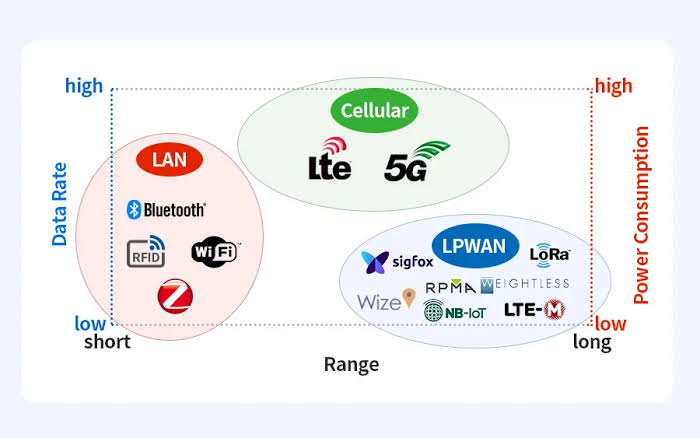
Conceptual comparison only. Actual range, data rate, and power demand vary by frequency, antenna design, transmit power, receiver sensitivity, device configuration, network conditions, duty cycle, and deployment environment.
Range is affected by more than a protocol name. Frequency, bandwidth, transmit power, receiver sensitivity, antenna efficiency and gain, line of sight, obstacles, building materials, interference, mounting position, and local regulations all influence the usable link.
Even within one technology, different physical-layer modes can produce different outcomes. The Bluetooth SIG, for example, explains that Bluetooth Low Energy PHY options trade data rate for effective range. Higher transmit power may also extend a link while increasing device power consumption.
For this reason, a statement such as “Technology A reaches farther than Technology B” should be treated as a general orientation rather than a project specification.
A soil sensor sending a small reading every hour has a very different requirement from a surveillance camera, access point, telematics gateway, or industrial controller.
Define at least:
LPWAN systems are generally designed around small and relatively infrequent messages. Wi-Fi and cellular broadband are better aligned with larger or more frequent data transfers, although the exact performance depends on the implementation and network.
“Low power” does not automatically mean long battery life. Battery life also depends on:
GSMA guidance for LTE-M and NB-IoT specifically notes that device software and network parameters affect whether a deployment achieves the low-power potential of these technologies.
Some technologies rely on an existing operator network. Others can use private gateways or local infrastructure. Before selecting a radio, determine:
The horizontal axis represents a movement from local links toward wider-area communication. The vertical axis represents a movement from low-throughput sensing toward higher-throughput applications. Bubble color represents relative end-device power demand in a typical use pattern:
This third variable is deliberately shown by color rather than a second vertical axis. Data rate and power consumption are related in many designs, but they are not interchangeable measurements and do not always rise together.
The bubbles overlap because wireless families also overlap. LTE-M and NB-IoT, for example, are both cellular technologies and LPWA technologies. Bluetooth LE can serve anything from very short links to much longer specialized links. Wi-Fi power demand varies substantially with the radio generation, traffic, sleep behavior, and device class.
Use the diagram to narrow the options, then verify the actual radio, frequency, antenna, and deployment requirements.
Bluetooth LE operates in the 2.4GHz ISM band and is designed for efficient device communication. Depending on the PHY, the Bluetooth SIG lists protocol data rates from 125 kb/s to 2 Mb/s. The coded PHY can extend effective range at the cost of a lower application data rate.
Bluetooth LE is commonly considered for sensors, beacons, access control, wearable devices, local configuration, asset tags, and connections to smartphones or tablets. It can use point-to-point, broadcast, and mesh topologies.
Selection questions include smartphone interoperability, message frequency, topology, required PHY, installation materials, interference, antenna space, and coexistence with Wi-Fi or another 2.4GHz radio.
Zigbee is a low-power mesh technology used in smart-home, commercial-building, utility, sensing, and control applications. The Connectivity Standards Alliance describes Zigbee as supporting low-power mesh networking and both 2.4GHz and Sub-GHz bands.
Mesh networking can extend coverage through participating nodes, but the result depends on node placement, routing, building layout, interference, and which devices are continuously powered. A mesh path should not be treated as the same thing as a single long-range radio link.
Wi-Fi is typically selected when an application needs local-network integration and higher throughput. It can suit cameras, access points, gateways, industrial devices, smart appliances, and products that already operate near Wi-Fi infrastructure.
Power demand varies greatly. A continuously active camera or access point has a different profile from a sensor using aggressive sleep scheduling. Range also depends on band, channel width, access-point placement, antenna pattern, building materials, congestion, and transmit-power rules.
For current product exploration, see EVERCOM's WiFi 6E antennas and 2.4GHz antenna category.
“RFID” covers passive and active systems, different frequency families, different readers, and very different operating distances. A passive tag with no battery should not be positioned on the same power scale as a battery-powered active tag without explanation.
For clarity, RFID is not assigned one bubble in the main diagram. If RFID is being evaluated, first define the tag type, frequency, read direction, reader power, antenna geometry, tag orientation, materials, and required read zone.
4G LTE and 5G broadband can support wide-area mobility, operator-managed coverage, and higher data volumes. They may be considered for industrial routers, fixed wireless access, connected vehicles, remote gateways, video, and equipment that needs frequent two-way communication.
This capability comes with system considerations:
"5G" is not one frequency or one power profile. Different 5G device and service profiles address different requirements. The radio module and operator deployment must be identified before an antenna is selected.
Related EVERCOM categories include 4G LTE antennas and 5G LTE antennas.
LPWAN is a family description rather than one protocol. It generally refers to technologies designed to connect many devices over a wide area while supporting small data transfers and lower device-power operation.
LoRaWAN is an LPWA networking architecture designed for battery-operated devices and can be deployed with private, shared, or public network models. The LoRa Alliance describes it as optimized for battery lifetime, capacity, range, and cost.
LoRaWAN can be considered for smart metering, agriculture, environmental sensing, building monitoring, city infrastructure, and remote status reporting. Frequency plans and permitted parameters vary by region, so the target countries must be identified before antenna and radio design.
LoRaWAN is not the same as LoRa. LoRa commonly refers to the radio modulation or physical layer, while LoRaWAN defines networking behavior above it.
Sigfox 0G is a low-power wide-area network designed around small messages and low-throughput Massive IoT applications. Its public technical material states that radio configurations and operating frequencies vary by region.
Before selecting Sigfox, verify current network availability, regional radio configuration, message and downlink requirements, mobility, coverage validation, device qualification, and the applicable antenna band.
NB-IoT is a 3GPP cellular LPWA technology. It is associated with low-throughput devices, extended coverage, and power-saving features on operator-managed licensed spectrum.
It may suit fixed or slowly changing devices such as meters, sensors, alarms, infrastructure monitoring, and other applications that send relatively small amounts of data. The final fit depends on operator support, bands, mobility requirements, latency, traffic, firmware updates, and power configuration.
LTE-M is also a 3GPP cellular LPWA technology. It supports a different balance of throughput, mobility, and device capability from NB-IoT. Which one is appropriate depends on operator availability and the application rather than a simple “better” ranking.
Projects that need mobility, more frequent communication, or a different latency and throughput profile may evaluate LTE-M, while very low-throughput fixed sensing may evaluate NB-IoT. This is a starting point only; the module, network, traffic, and coverage plan must be verified.
Technology diagrams often separate “cellular” and “LPWAN” into different bubbles. That is useful for showing broadband versus low-throughput behavior, but it can hide an important fact: NB-IoT and LTE-M are standardized cellular LPWA technologies using licensed spectrum.
The practical comparison is therefore:
This classification helps buyers ask the right questions about network ownership, coverage, subscriptions, frequency bands, mobility, power modes, and gateway requirements.
The two terms look similar but refer to different frequency concepts.
Sub-GHz generally means radio operation below 1GHz. Depending on the region and technology, it can include unlicensed or licensed bands used for sensing, metering, control, LPWAN, or other radio applications.
Sub-6GHz generally means frequencies below 6GHz. In 5G discussions it commonly refers to 5G NR Frequency Range 1, which includes both lower cellular bands and mid-band spectrum. It is contrasted with millimeter-wave 5G.
An antenna for a Sub-GHz sensor is not automatically a 5G Sub-6GHz antenna. The exact frequency list must be checked.
For separate product contexts, visit EVERCOM's Sub Ghz Technology page and SUB-6G antenna category.
The table uses relative descriptions because the exact result depends on the implementation.
| Technology family | Typical coverage profile | Typical data profile | Relative device-power profile | Network model | Common starting applications |
|---|---|---|---|---|---|
| Bluetooth LE | Local; can be extended with coded PHY or mesh | Low to medium | Lower | Direct, broadcast, or mesh | Sensors, beacons, wearables, access, configuration |
| Zigbee | Local mesh or building-area coverage | Low | Lower | Private mesh | Smart home, building control, lighting, metering |
| Wi-Fi | Local network or building/campus coverage | High | Medium to higher | Private or managed WLAN | Cameras, gateways, appliances, access points |
| 4G/5G broadband | Wide-area operator coverage | Medium to very high | Medium to higher | Licensed operator network | Routers, vehicles, video, gateways, FWA |
| LoRaWAN | Wide-area; private or public deployment | Low | Lower | Private, shared, or public LPWAN | Metering, agriculture, environment, monitoring |
| Sigfox 0G | Wide-area where service is available | Very low | Lower | Managed LPWAN | Small sensor messages, tracking, alarms |
| NB-IoT | Wide-area operator coverage | Low | Lower when properly configured | Licensed operator LPWA | Meters, fixed sensing, alarms, infrastructure |
| LTE-M | Wide-area operator coverage | Low to medium | Low to medium when properly configured | Licensed operator LPWA | Tracking, mobile sensing, telematics, monitoring |
| Application requirement | Technologies to evaluate first | Questions that can change the decision |
|---|---|---|
| High-throughput video or frequent large data | Wi-Fi; 4G/5G broadband | Is local infrastructure available? Is mobility required? |
| Smartphone-connected sensor or accessory | Bluetooth LE | Required range, PHY, update size, background operation, and coexistence |
| Building automation with many low-data nodes | Zigbee; Bluetooth Mesh; Wi-Fi for gateways | Mesh density, mains-powered routers, interference, and local operation |
| Remote battery-powered meter | LoRaWAN; NB-IoT; LTE-M; Sigfox where available | Coverage, gateway ownership, operator support, traffic, downlink, and target battery life |
| Agricultural or environmental monitoring | LoRaWAN; cellular LPWA; other suitable Sub-GHz systems | Terrain, antenna height, private gateways, regional band, and maintenance access |
| Moving asset or vehicle | LTE-M; 4G/5G; other operator-supported tracking options | Mobility, roaming, reporting interval, coverage, and data volume |
| Industrial gateway | Ethernet/Wi-Fi plus 4G/5G or LPWAN backhaul as required | Primary versus backup link, site coverage, antenna placement, and remote management |
These are evaluation starting points, not final prescriptions. A field trial is often necessary.
A protocol name does not fully define an antenna. After selecting a radio technology, prepare the engineering requirements below.
Identify the countries, operators, channel plans, and radio-module variants. “LoRa,” “LTE,” “5G,” or “Wi-Fi” is not a complete frequency specification.
Peak gain alone is not enough. Review efficiency and pattern across the required bands and in the final installation. A directional antenna can improve a fixed link in a known direction, while an omnidirectional pattern may be more suitable when device orientation or signal direction varies.
Metal, batteries, displays, PCBs, cables, housings, walls, cabinets, vehicles, and ground planes can change antenna behavior. Validate the antenna in the production-intent device and mounting position.
Define connector family, gender, polarity, cable type, length, insertion loss, routing, bend radius, strain relief, and environmental exposure. At higher frequencies, cable and adapter losses can materially affect the link.
Cellular MIMO, Wi-Fi MIMO, GNSS, Bluetooth, and other radios may share the same enclosure. Confirm port functions, spacing, isolation, and coexistence requirements. A multi-cable assembly should have an unambiguous port map.
The approved radio, antenna, gain, cable, and installation may be part of the device's compliance conditions. Review changes with the module supplier, device manufacturer, test laboratory, and network operator as applicable.
Before requesting an antenna or connectivity recommendation, prepare:
No. Range depends on frequency, bandwidth, modulation, coding, antenna performance, receiver sensitivity, data rate, environment, and link budget as well as transmit power. Increasing transmit power can increase power consumption, but it is only one part of the system.
Not in every operating mode. Wi-Fi is generally used for higher-throughput local connectivity, while LPWAN is designed around lower-throughput, wider-area IoT communication. Actual energy use depends on traffic, sleep behavior, signal quality, protocol overhead, and hardware.
There is no universal answer. Both families include different generations, bands, channel widths, network loads, device capabilities, and deployment conditions. Compare the required application throughput and the actual available network, not only the technology label.
LoRa commonly refers to the radio modulation or physical layer. LoRaWAN defines a networking architecture and protocol used above the LoRa radio layer.
Both are 3GPP cellular LPWA technologies. They provide different balances of mobility, throughput, latency, device complexity, and network features. Operator availability and the application requirements should guide the decision.
No. Sub-GHz generally refers to frequencies below 1GHz. In 5G discussions, Sub-6GHz refers to the broader range below 6GHz. The terms are not interchangeable.
There is no single longest-range antenna for every project. The correct antenna must match the frequency, pattern, gain, efficiency, radio power, receiver sensitivity, cable, installation, regulatory limits, and required coverage direction.
Wireless technology selection and antenna selection should be handled as one system-design process. Start with the application traffic, power source, network model, target markets, and installation. Then provide the exact radio bands, module, enclosure, connector, cable, MIMO, and validation requirements.
Explore EVERCOM's public WiFi 6E, 2.4GHz, 4G LTE, 5G LTE, and SUB-6G antenna categories. For a project-specific assessment, contact EVERCOM with the device, frequency, market, installation, and interface requirements.