Close
Your shopping cart is empty


Sub-GHz technology is widely used for wireless systems that prioritize low power consumption, dependable coverage, and communication through common building obstacles. It is frequently considered for sensing, monitoring, control, and automation applications.
Sub-GHz refers to wireless communication operating below 1 GHz. Compared with higher-frequency alternatives, it can offer favorable propagation characteristics for devices that transmit modest amounts of data over practical distances while operating on limited power.
Lower-frequency signals can support useful communication ranges in outdoor, industrial, and building environments.
Sub-GHz signals may travel through walls and common obstructions more effectively than higher-frequency signals in comparable conditions.
It is well suited to sensors, meters, and control devices designed for extended operation with limited energy resources.
Many deployments use Sub-GHz for periodic data, alerts, status updates, and remote-control commands rather than high-bandwidth media.
| Consideration | Sub-GHz | 2.4 GHz |
|---|---|---|
| Typical design priority | Coverage, penetration, and low power | Higher data capacity and broad device compatibility |
| Data profile | Low to moderate data volume | Often suitable for higher data volume |
| Common environments | Metering, monitoring, control, security, and industrial sensing | Wi-Fi, Bluetooth, consumer electronics, and multimedia devices |
| Project planning | Regional band and regulatory requirements must be confirmed | Coexistence and congestion in a widely used band should be considered |
Actual results depend on the complete RF system and deployment environment; frequency alone does not determine performance.
Periodic transmission of utility data and device status.
Remote sensing, alarms, equipment monitoring, and control.
Low-power control links for connected building devices.
Sensors, access control, alerts, and perimeter monitoring.
Selected monitoring and remote-control applications.
Distributed devices that send small, periodic data updates.
For a related system example, see Smart Metering Application.
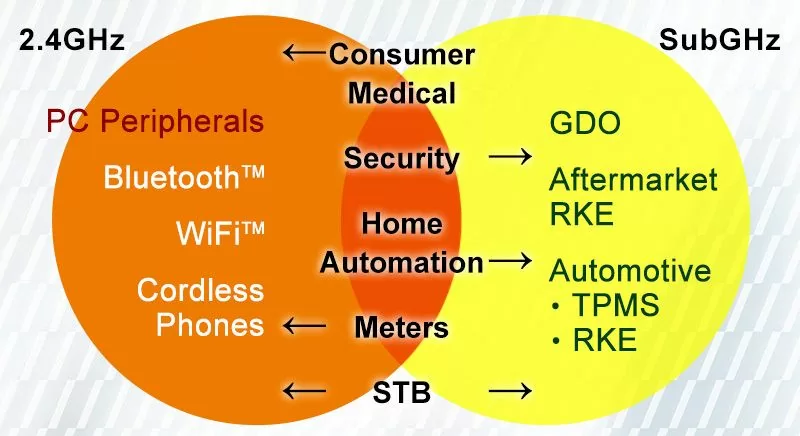
Sub-GHz is commonly selected when coverage, obstacle penetration, or low-power operation is important. The 2.4 GHz band is often selected for broader compatibility and higher data-rate applications.
It can be suitable for meter readings, status messages, and other periodic low-data communications. The final design depends on the protocol, installation, coverage target, and local regulations.
No. Permitted bands and operating conditions vary by country or region. The target market should be confirmed at the beginning of the project.
Antenna design, transmit power, receiver sensitivity, installation position, cable loss, obstacles, interference, and environmental conditions all affect range.
Useful project information includes the target market, required band, device dimensions, installation position, enclosure materials, connector or cable needs, operating environment, and expected quantity.
Share your target market, frequency requirements, device structure, installation environment, and expected quantity with EVERCOM for an initial project discussion.
Contact EVERCOM