Close
Your shopping cart is empty


To achieve centimeter-level or even millimeter-level accuracy, RTK (Real-Time Kinematic) relies heavily on eliminating multipath interference and ensuring phase center stability.
Multipath interference refers to the delay in phase ranging caused by satellite signals being reflected from buildings, the ground, or drones.
Principle: Ground station antennas commonly use concentric circular metal trenches (approximately λ/4 deep). When low-elevation-angle signals or reverse-polarized waves reflected from the ground are incident, high impedance is generated within the trench, preventing surface waves from entering the central antenna element.
Lightweight Improvements for UAVs: Airborne antennas cannot support heavy traditional chokes; therefore, a ceramic micro strip structure + EBG (Electromagnetic Bandgap) grounding substrate is used to block refracted waves through geometric microstructure.
GNSS direct waves are right-hand circularly polarized (RHCP), which reverses to left-hand circularly polarized (LHCP) after a single reflection. High-precision RTK antennas minimize cross-polarization gain, maintaining extremely high axial ratio purity (Axial Ratio <1.5 dB), enabling the antenna to have an ultra-high attenuation rate (>20 dB suppression) for LHCP signals, directly filtering reflected waves at the physical layer.
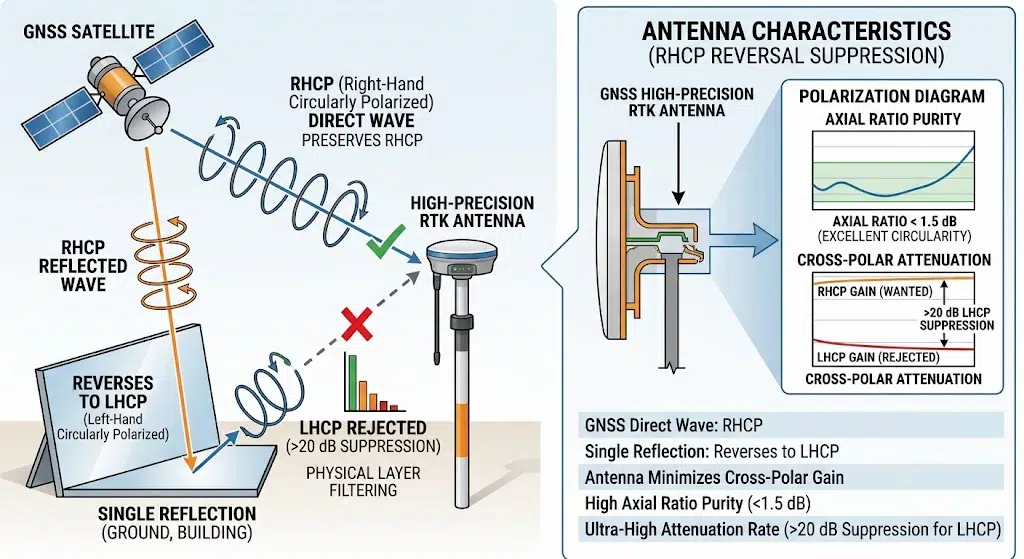
RTK GNSS anti-multipath and RHCP reversal-suppression diagram supplied with the approved article.
The "electrical phase center" of a GNSS antenna receiving signals is not a fixed physical point; it varies with the signal's incident angle (Elevation/Azimuth).
Phase Center Offset (PCO): The fixed three-dimensional distance between the physical geometric center and the average phase center.
Phase Center Variation (PCV): Dynamic fluctuations that occur with changes in satellite elevation angle.