Close
Your shopping cart is empty


Modern cellular equipment may use multiple antenna paths to improve link reliability, capacity, or data throughput when the modem and network support the corresponding MIMO mode. For gateways, routers, industrial terminals, vehicle devices, and IoT systems, selecting a MIMO antenna is therefore more complex than choosing one frequency range and connector. The design team must map every modem port to an antenna path and confirm how the complete assembly behaves inside its real enclosure.
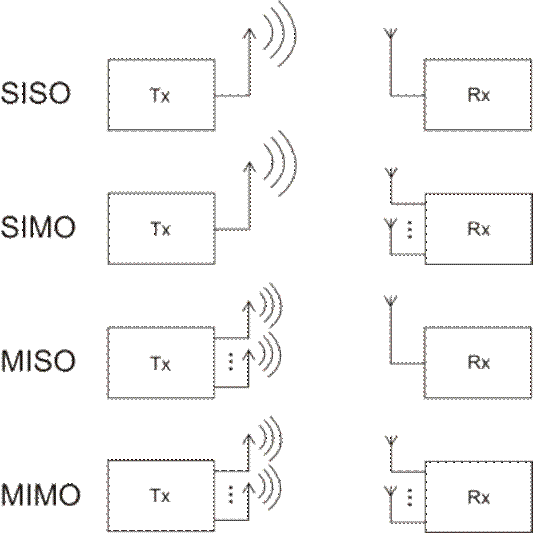
SISO uses one transmit path and one receive path. SIMO uses one transmit path and multiple receive paths, while MISO uses multiple transmit paths and one receive path. MIMO uses multiple transmit and receive paths. In commercial equipment, the exact behavior depends on the modem, network, supported standard, radio conditions, and software configuration.
| Architecture | Radio paths | Typical design implication | Questions to confirm |
|---|---|---|---|
| SISO | One main antenna path | Simpler integration and fewer RF connections | Does the modem require only one active antenna port? |
| 2x2 MIMO | Two coordinated antenna paths | Requires two suitable antennas or two elements in one housing | Which ports are main and auxiliary, and which bands must both paths cover? |
| 4x4 MIMO | Four coordinated antenna paths | Needs more space, connectors, cable routing, and isolation planning | Does the modem support 4x4 on every required band or only selected bands? |
| Combination system | Cellular plus GNSS, Wi-Fi, or other radios | Multiple functions share a housing or installation area | How are ports labeled, isolated, powered, and validated? |
Do not determine antenna count from marketing terminology alone. Start with the modem hardware guide and product architecture. Some ports may be required for cellular MIMO, while others may serve GNSS, Wi-Fi, Bluetooth, or another function. Each cable and connector should be mapped before samples are ordered.

The modem and network determine whether a device can use 2x2 or 4x4 MIMO. Adding antennas beyond the supported architecture does not automatically create additional MIMO streams. The product team should review the module's port definitions, supported bands, carrier requirements, and intended operating modes.
A 2x2 design is generally easier to package because it needs fewer elements and cables. A 4x4 design increases the number of physical paths and may require substantially more antenna area, careful placement, and connector management. The enclosure must provide enough separation and diverse orientations without blocking the user interface, battery, display, heat sink, or other radios.
“4G antenna” and “5G antenna” are broad categories. Suitability depends on the exact operating bands used by the modem and deployment markets. A product may need low, mid, and higher cellular bands, and the antenna behavior can vary considerably across a wide frequency range.
Prepare a band-and-port matrix before selecting samples. List the modem port name, function, supported bands, required antenna type, connector, cable, and any installation restriction. Confirm whether auxiliary ports are receive-only in certain modes or used as full MIMO paths. When regional variants use different modules or band combinations, identify which antenna configuration is shared and which must change.
The product should be evaluated with the actual modem configuration. Firmware, carrier profile, operating band, and network conditions affect system testing, so RF measurements and field behavior should not be interpreted without recording the test state.
MIMO relies on multiple antenna paths that experience sufficiently different signal conditions. In a compact device, physical spacing may be limited, so orientation, polarization, antenna type, ground structure, and surrounding materials become important design tools. There is no single spacing value that works for every enclosure and frequency.
Isolation is one useful measurement, but it should not be used alone to approve a design. Matching, efficiency, radiation pattern, correlation-related behavior, receiver performance, throughput, and the intended operating modes may all be part of the engineering review. The appropriate metrics and acceptance limits should be agreed for the specific project.
Internal antennas support a clean exterior and can simplify user installation, but their performance is closely tied to the enclosure, PCB, ground structure, battery, display, and assembly tolerances. They should be tuned and validated inside a representative device.
External antennas can offer flexible placement and may move the radiator away from shielding materials. However, the project must manage connectors, cable loss, installation orientation, user access, mechanical retention, and environmental exposure.
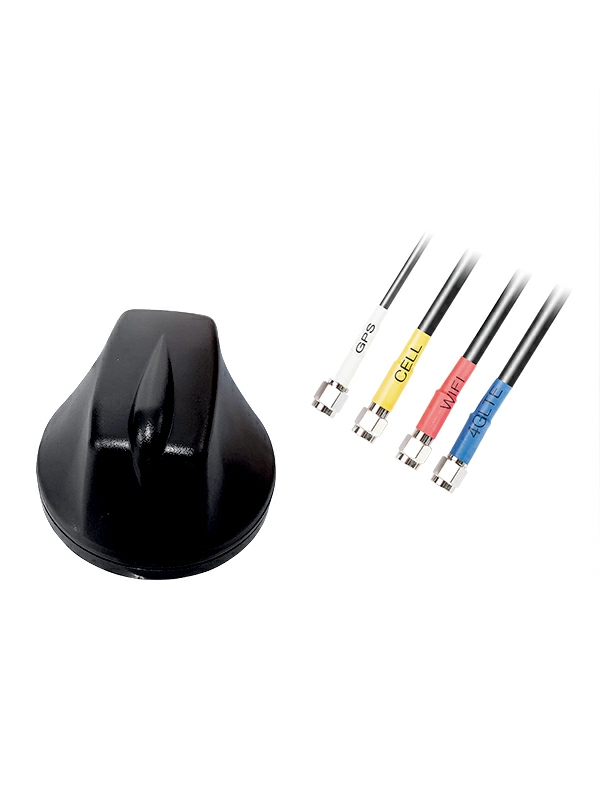
A combination antenna places multiple cellular elements—and sometimes GNSS or Wi-Fi elements—inside one housing. It can consolidate installation, but each path still needs correct cable identification, connector mapping, internal isolation, and system validation.
The enclosure is part of the antenna environment. Metal panels, conductive coatings, batteries, displays, wiring, heat sinks, fasteners, and cable shields can change antenna tuning or radiation. Product teams should define antenna keep-out areas and review mechanical changes before tooling and layout are frozen.
Every MIMO path should use the specified connector, cable, and length. Longer cables and additional adapters add loss and can make paths unequal. Cable routing should avoid sharp bends, excessive strain, moving mechanisms, noisy electronics, and uncontrolled contact with metal. Labels or color coding can help production connect each antenna to the correct modem port.
Testing should progress from component-level checks to evaluation in the final device. Early engineering samples can reveal integration conflicts. Approval samples should represent the intended enclosure materials, antenna positions, cables, connectors, and assembly process.
Record the device revision, modem firmware, band, network or test setup, antenna revision, cable routing, orientation, and enclosure state. Without controlled conditions, differences between samples may be difficult to interpret.
| RFQ category | Information to provide | Purpose |
|---|---|---|
| Device and markets | Application, installation, target countries, operators, and expected orientation | Defines deployment conditions and required band coverage. |
| Modem architecture | Module model, port map, 2x2 or 4x4 modes, bands per port, and other radios | Determines antenna count and functional mapping. |
| Mechanical package | Drawings, enclosure material, PCB, ground, battery, display, and available antenna zones | Supports feasibility and placement review. |
| RF interfaces | Connector, cable type, length, labels, exit direction, and routing | Prevents incompatible samples and unequal path loss. |
| Validation | Required measurements, device tests, environments, reports, and approval process | Creates a shared completion definition. |
Also provide prototype quantity, forecast, schedule, packaging, and any fixed appearance or installation requirements. Mark which points are mandatory and which can be optimized with the antenna supplier.
It requires the antenna paths defined by the modem design, but the band coverage and physical antenna implementation may vary. Confirm the module's port requirements and validate every path in the final device.
Compact products often have limited spacing, but the result depends on frequency, orientation, polarization, enclosure, ground structure, coupling, and system algorithms. The arrangement must be measured rather than approved from spacing alone.
No. External antennas can provide placement flexibility, while internal antennas can suit integrated products. Performance, installation, environment, cable loss, serviceability, and product appearance should be considered together.
A multi-port modem may assign different functions to its connectors. Clear labels reduce incorrect assembly and make engineering tests, service, and production inspection more repeatable.
Send the modem and port map, required bands, target markets, device drawings, available antenna space, enclosure and ground information, connector and cable requirements, installation, validation plan, sample quantity, forecast, and schedule.
A successful 4G/5G MIMO design begins with the modem architecture and ends with verification in the actual product. Antenna count, frequency coverage, spacing, orientation, enclosure, ground, cables, connectors, assembly, and software configuration must work together.
Explore Evercom's MIMO antenna solutions and 5G LTE antenna range, review the SISO, SIMO, MISO, and MIMO overview, revisit the antenna selection guide, or contact Evercom with your modem, device, and installation requirements.